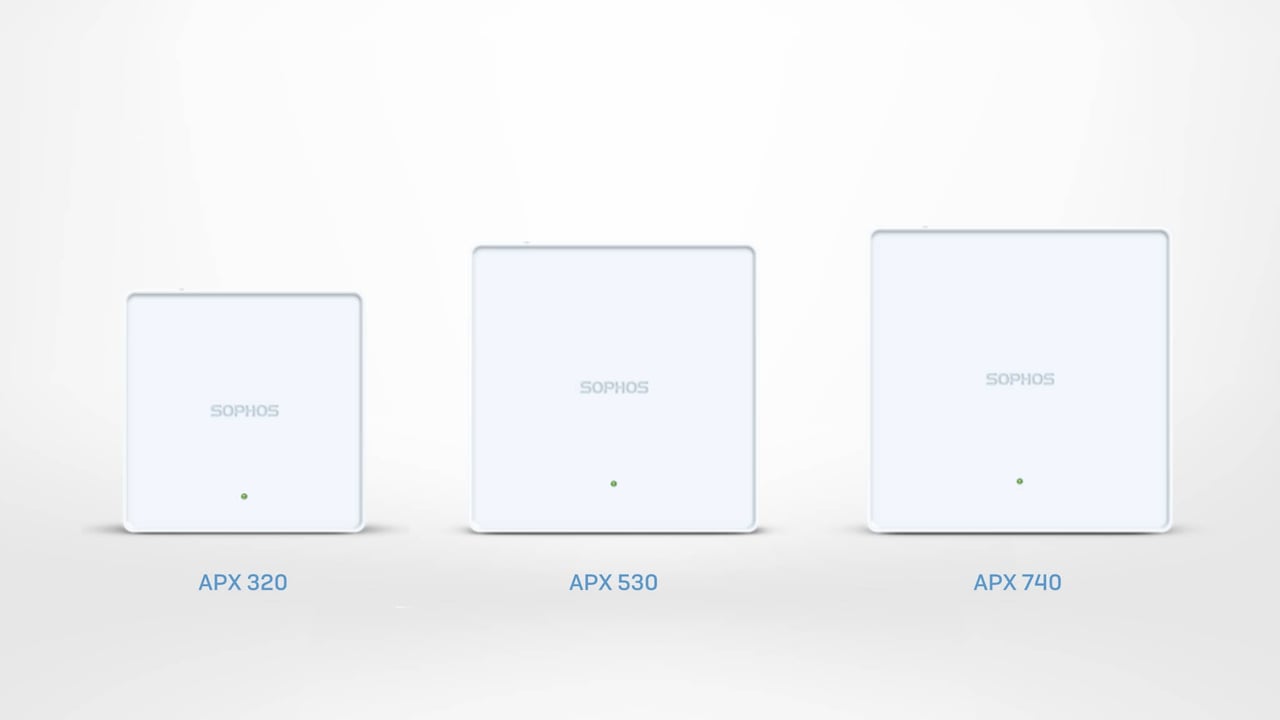
Sophos Access Points – New APX Series with Wave 2.0
In our infamous blog post Sophos Roadshow 2018: See the Future we reported that Sophos would be launching new access points. Sophos has now delivered on that promise and we’re delighted to introduce the new models in more detail.
That post became “famous” because many people appreciated seeing a public roadmap from Sophos and we received great feedback from our customers. Unfortunately, it also caused some waves at Sophos, which is why we have to call it “infamous” as well. 😅
Note: If you don’t need much background and just want the hardware, you can order the new Sophos access points directly from our website:
APX 320, APX 530, APX 740
Effective immediately, there are three new Sophos access points: APX 320, APX 530 and APX 740. All of them support the Wave 2 standard.
Note: Wave 2 delivers higher data rates and allows communication with up to four different clients simultaneously (MU‑MIMO). Channel width is doubled (80 MHz → 160 MHz) and throughput increases from 1.3 Gbit/s with Wave 1 to up to 3.6 Gbit/s with Wave 2.
Sophos APX 740
We’ll start with the flagship of the third generation of Sophos access points, the APX 740. Compared with the AP 100 it is expected to deliver roughly three times the performance. It is designed for environments with many users and high capacity requirements.
- Deployment scenario: Indoor (desktop, wall or ceiling mount)
- Wi‑Fi standards: 802.11 a/b/g/n/ac
- Radios: 1× 2.4 GHz single band, 1× 5 GHz single band, 1× Bluetooth Low Energy (BLE)
- Antennas: 4× internal 2.4 GHz for radio 1, 4× internal 5 GHz for radio 2, 1× internal 2.4 GHz BLE
- Performance: 4×4:4 MU‑MIMO (1.7 Gbps + 450 Mbps), max. speed up to 3.6 Gbps @ 160 MHz
- Interfaces: 1× RJ45 console serial port, 1× RJ45 10/100/1000 Ethernet, 1× RJ45 10/100/1000 Ethernet with PoE
- Power max.: 22.4 W
- PoE min.: PoE+ 802.3at
- Dimensions: 195×195×43 mm
- Weight: 1012 g
➜ View the Sophos APX 740 in our shop.
Sophos APX 530
The APX 530 is the ideal replacement for customers who would previously have chosen an AP 100 in terms of size and performance. The difference now is that the APX 530 offers roughly twice the performance of an AP 100. It is well suited to offices with several employees and high capacity demands.
- Deployment scenario: Indoor (desktop, wall or ceiling mount)
- Wi‑Fi standards: 802.11 a/b/g/n/ac
- Radios: 1× 2.4 GHz single band, 1× 5 GHz single band, 1× Bluetooth Low Energy (BLE)
- Antennas: 3× internal 2.4 GHz for radio 1, 3× internal 5 GHz for radio 2, 1× internal 2.4 GHz BLE
- Performance: 3×3:3 MU‑MIMO (1.3 Gbps + 450 Mbps), max. speed up to 2.6 Gbps @ 160 MHz
- Interfaces: 1× RJ45 console serial port, 1× RJ45 10/100/1000 Ethernet, 1× RJ45 10/100/1000 Ethernet with PoE
- Power max.: 16.7 W
- PoE min.: PoE+ 802.3at
- Dimensions: 183×183×39 mm
- Weight: 922 g
➜ View the Sophos APX 530 in our shop.
Sophos APX 320
The APX 320 is the entry‑level model in the new APX Series, but still delivers around twice the performance of an AP 55. It is a great choice for retail environments or schools where many smartphones and tablets need to connect.
- Deployment scenario: Indoor (desktop, wall or ceiling mount)
- Wi‑Fi standards: 802.11 a/b/g/n/ac
- Radios: 1× 2.5 GHz/5 GHz dual‑band, 1× 5 GHz single band
- Antennas: 2× internal dual‑band 2.4 GHz antennas for radio 1, 2× internal 5 GHz antennas for radio 2, 1× internal 2.4 GHz BLE
- Performance: 2×2:2 MU‑MIMO (867 Mbps + 300 Mbps), max. speed up to 1.7 Gbps
- Interfaces: 1× RJ45 console serial port, 1× RJ45 10/100/1000 Ethernet with PoE
- Power max.: 11.5 W
- PoE min.: PoE+ 802.3af
- Dimensions: 155×155×38 mm
- Weight: 474 g
➜ View the Sophos APX 320 in our shop.
Sophos APX 120
So far we’ve only talked about three new access points. A fourth model, the APX 120, is expected in November. This cost‑effective device is likely to be used in small offices, living rooms, small shops or branch locations. Unfortunately there are no technical details available yet.
Management
As you probably know, Sophos access points require a “wireless controller”. Up to now you could use Sophos Central, an SG firewall or an XG firewall. Initially, however, the new APX models will only be supported by Sophos Central Wireless 2.0 in Sophos Central. XG Firewall will receive an update to its wireless module in Q4 2018. Customers still running the UTM operating system are, for the first time, really missing out when it comes to support for the new access points: as one Sophos slide puts it, “No support in SG UTM planned”. UTM customers can either migrate to Sophos Firewall OS or manage the new APX models via Sophos Central.
Update (30.09.2019): Sophos has changed its mind and is adding APX support to all SG firewalls via the UTM v9.700 update.
For XG users it’s slightly annoying that they’ll have to wait until the end of 2018. For organizations still running UTM, the initial plan was more like a slap in the face. Smaller environments can be migrated relatively quickly, but the same can’t be said for larger enterprises.
Synchronized Security – Wireless
The new APX access points – and only these models – also support Synchronized Security. Just like Synchronized Security on the endpoint, this allows infected mobile devices to be isolated so that other clients aren’t compromised and sensitive data can’t leak out.
On the endpoint side you’ll need Sophos Central Mobile or Sophos Central Endpoint.
FAQ
What happens to the previous models AP 15, AP 15c, AP 55, AP 55c, AP 100, AP 100c, AP 100x?
Why are there no more C‑models in the APX Series?
When will the new models be available?
What about the AP 100x? Will there be a successor?
Conclusion
The new APX Series is a strong update in terms of both performance and design. We’ll be ordering all the models and publishing a detailed review. With the AP 55 and AP 100 we often reached their limits during large downloads and with many users. We’re hopeful that the new APX Series will put an end to those bottlenecks.