
Set up Sophos SSL VPN with Sophos Connect on Windows
SSL VPN remains an important remote access option on Sophos Firewall, especially when IPsec causes problems in hotels, guest networks or heavily filtered third-party networks. On Windows, SSL VPN is now used in many environments through Sophos Connect.
This article explains the installation on Windows, importing the .ovpn configuration and the most important checks after the connection is established. For the basic choice between Sophos Connect, SSL VPN, IPsec, mobile clients and ZTNA, start with Sophos Connect or SSL VPN: which remote access solution fits?.
Download Sophos Connect for Windows: the quick route
For Sophos Firewall with SFOS, Sophos Connect is available from the organisation’s VPN Portal. IT provides the portal address and VPN access. The installer alone does not contain a connection to the company network; a personal SSL VPN profile or a provisioning file supplied by IT is also required.
If SSL VPN is already configured and IT has approved the installation:
- Sign in to the VPN Portal with the personal VPN user account. If a certificate warning appears, first check the address and certificate with IT.
- Under VPN > Sophos Connect client > Download for Windows, download and install the approved package. An existing old Sophos SSL VPN Client must be removed first; clarify local installation rights or software deployment with IT.
- Under VPN configuration > Download configuration for Windows, macOS, Linux, select Use with Sophos Connect and OpenVPN Connect v2 clients and download the personal
.ovpnfile. - In Sophos Connect, open Import connection, import the
.ovpnand sign in with Connect. Confirm MFA if configured, then check internal names and the required application.
The .ovpn contains a personal certificate and private key and must not be shared. If the download is missing from the portal, IT must check the SSL VPN permission. If the client is centrally deployed or .pro provisioning is used, follow the supplied workflow; an additional manual profile import is then unnecessary. The prerequisites and individual steps are explained in detail below.
Context
These instructions apply to Sophos Firewall with SFOS. Depending on the platform or starting point, another entry point may fit better:
- Set up SSL VPN with Sophos Connect on Windows: This article.
- Set up SSL VPN on macOS: Set up Sophos SSL VPN on macOS.
- Set up SSL VPN on iOS: Set up Sophos SSL VPN on iOS.
- Evaluate Sophos Connect in general: Sophos Connect or SSL VPN: which remote access solution fits?.
- Maintain Sophos Connect client versions and profiles: Check the Sophos Connect client version and update it safely.
Important: Sophos Connect supports SSL VPN not only on Windows. Since Sophos Connect 2.0, Remote Access SSL VPN has also been available on macOS. Mobile platforms such as iOS and Android are not directly supported by Sophos Connect for IPsec and SSL VPN; OpenVPN-compatible clients or operating system functions are used there.
Requirements
- Sophos Firewall with configured SSL VPN remote access
- user with permission for SSL VPN
- access to the VPN Portal or an administratively provided
.ovpnfile - Sophos Connect in a current version suitable for the Windows platform
- Windows 10 or Windows 11, and Windows ARM with Sophos Connect 2.5 or later
- no Windows 11 Enterprise multi-session or Azure Virtual Desktop with Sophos Connect 2.5 or later
- no old Sophos SSL VPN Client installed in parallel
- MFA/OTP configured if Remote Access is protected by it
- firewall rules for traffic from the
VPNzone - a clear process for distributing new
.ovpnfiles after changes
If the firewall-side SSL VPN configuration is not yet in place, first complete Set up Sophos Firewall SSL VPN Remote Access.
Before an SFOS 22 MR1 upgrade, also check whether old Remote Access IPsec configurations still exist. SSL VPN is not directly affected by this, but many environments reassess Remote Access at this point. The process is described in Migrate legacy Remote Access IPsec before SFOS 22 MR1.
Plan before downloading
Before users download the client, it should be clear how SSL VPN will be operated. Many later errors do not come from the installation, but from old profiles, unclear permissions or overly broad firewall rules.
Important planning questions:
- Users: Which users or groups are authorised as Policy members for SSL VPN?
- Portal: Does the VPN Portal need to be reachable from the internet, or is the
.ovpnfile distributed administratively? - Certificate: Does the certificate match the public FQDN and does the browser show no warning?
- MFA: Is OTP/MFA requested for Remote Access and is the token rollout complete?
- DNS: Are internal DNS servers and search domains required?
- Access: Which internal networks and services may be reached from the
VPNzone? - Operations: Who updates Sophos Connect and distributes new profiles after changes?
If the VPN Portal is publicly reachable, it should not be treated as a simple download page. It is a firewall login service and part of the attack surface. Device Access, certificate, MFA, logging and possible source or country restrictions should therefore be reviewed deliberately.
1. Log in to the VPN Portal
Open the Sophos Firewall VPN Portal in the browser. By default, the address is https://<Firewall-FQDN>:443, unless the port has been changed. Then log in with the VPN user.
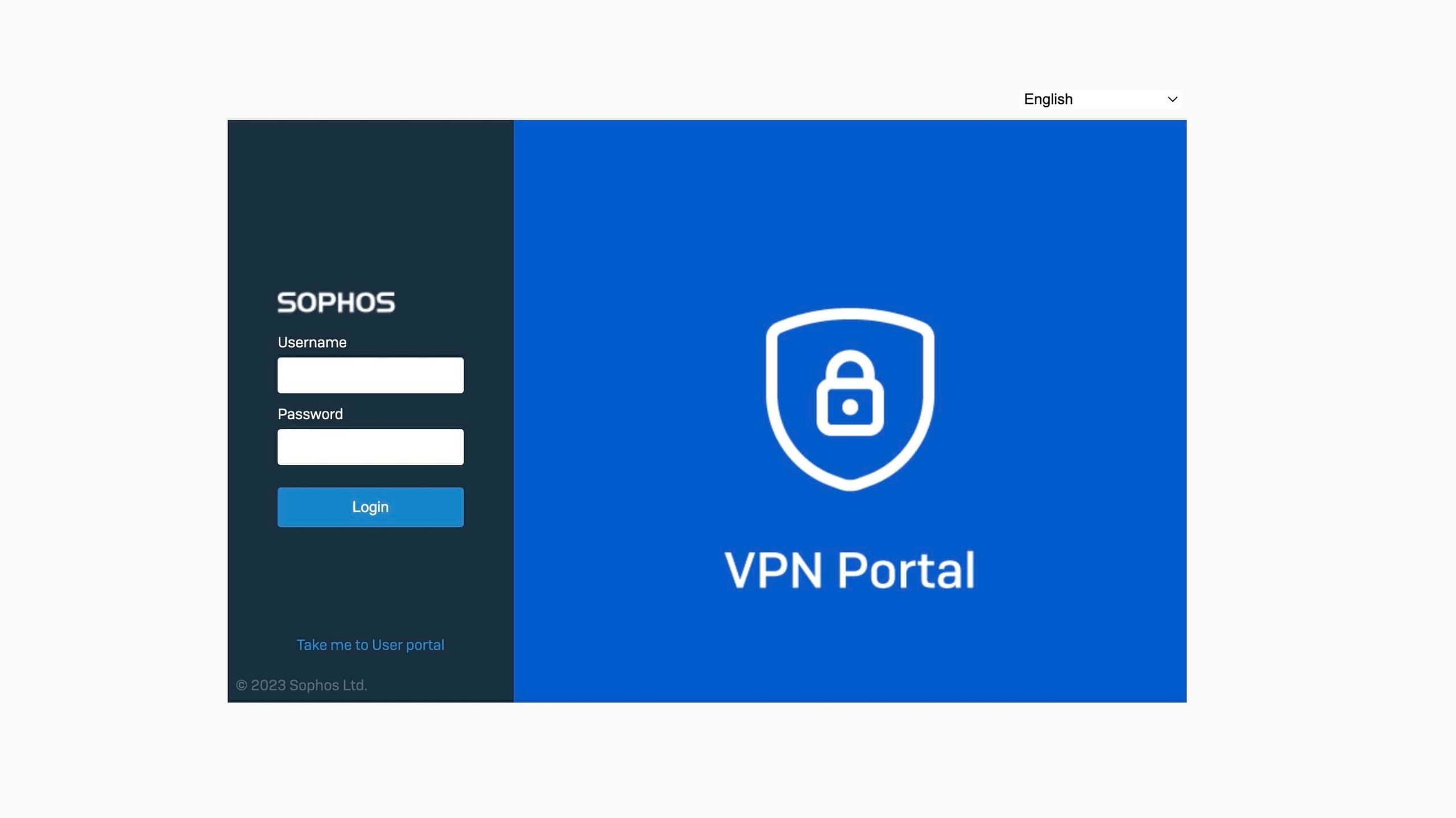
If the browser warns about the certificate, check the cause. In production environments, a valid certificate for the VPN Portal is cleaner than a permanent browser exception. For public portals, certificate, MFA and Device Access are not minor details, but part of Remote Access security. Device Access and Local Service ACL on Sophos Firewall is a suitable hardening reference.
If the user does not see an SSL VPN configuration after successful login, this is rarely a Windows problem. First check whether the user or their group is included in the matching SSL VPN policy as Policy members and whether the correct portal is being reached.
2. Download Sophos Connect and the SSL VPN configuration
In the VPN Portal, switch to the VPN area. The Sophos Connect client and SSL VPN configuration are provided there.
For the manual Sophos Connect workflow on Windows:
- Under Sophos Connect client, select Download for Windows if the client is not distributed centrally.
- Under VPN configuration, select Download configuration for Windows, macOS, Linux for the required SSL VPN configuration.
- Select Use with Sophos Connect and OpenVPN Connect v2 clients. The Use with OpenVPN Connect v3 clients option is intended for OpenVPN Connect 3, not Sophos Connect.
- Store the downloaded
.ovpnfile securely and import it into Sophos Connect later.

.ovpn configuration are provided in the VPN Portal; the file should match the current firewall configuration.For SFOS, do not obtain the client from the UTM download page. Users download it from the VPN Portal as described above. Administrators can find the same package in WebAdmin under Remote access VPN > SSL VPN > Download client. The latest version is available there when pattern updates are updated automatically under Backup & firmware > Pattern updates. Before rollout, verify the provided version by following Check the Sophos Connect client version and update it safely.
In managed environments, the client should not be installed randomly. A defined software package with a clear version, test group and update process is better. The approved version should be derived from the official release notes, the VPN Portal or the internal software package, not from individual downloads on user devices. Current Sophos Connect versions also include security and component updates, for example for OpenVPN or OpenSSL.
If an old Sophos SSL VPN Client is still installed on the Windows device, it must be uninstalled before Sophos Connect is installed. Sophos states that Sophos Connect cannot operate alongside another existing VPN client. Maintaining several clients and profiles in parallel also quickly leads to incorrect adapters and unclear support cases.
Alternatively, an administrator can provide a .pro provisioning file on Windows. Sophos Connect uses it to retrieve the .ovpn configuration assigned to the user from the VPN Portal and can automatically obtain subsequent changes. This workflow requires a reachable VPN Portal with a trusted certificate. The detailed provisioning and GPO configuration is covered in Configure Sophos Connect on Sophos Firewall.
3. Install Sophos Connect
Run the setup, accept the licence terms, click Install, and complete the wizard with Finish. For an upgrade, download and install the current approved package. Uninstalling first is not a blanket requirement for every Sophos Connect upgrade; use uninstall/reinstall only as a controlled repair or rollback path justified for the versions involved.

If a network adapter has to be confirmed during installation, this belongs to the VPN client. In managed Windows environments, this step should be properly prepared through software deployment or local admin rights.
After installation, document the Sophos Connect version. This helps later in support cases, because client errors, profile errors and firewall errors otherwise quickly get mixed together. For ongoing operation, follow the process to check the Sophos Connect client version and update it safely.
For rollback, retain the previously approved installer before rollout, provided that version is still permitted internally. If the pilot fails with the new version, disconnect the VPN, uninstall the new client and reinstall the previously approved package. Sophos states that a client update alone does not invalidate existing configuration files; after rollback, still verify the version, profile, connection, DNS and access again.
Deploy through a GPO startup script
For a centrally managed rollout, Sophos documents installation through an Active Directory GPO startup script. Save the batch file with a .bat extension and add it in Group Policy Management Console at Group Policy Management > [applicable GPO] > Computer Configuration > Policies > Windows Settings > Scripts > Startup. Point the installer path at the approved package on a share that endpoint computer accounts can read. Sophos’ silent MSI example is:
Adapt before rollout: The vendor example below is not a rollout file that can be run unchanged. The path after /i must identify the complete MSI file, including its filename and .msi extension, not just its folder; enclose the path in quotation marks. An installation line to adapt is, for example, msiexec.exe /i "\\fileserver.example.test\Software\SophosConnect.msi" /QN /norestart /L*V "C:\Windows\Temp\SophosConnect-install.log". Replace the server, share and filename with the actual values. /QN hides the interface, /norestart prevents an automatic restart and /L*V writes a verbose installation log. Schedule any required restart for a maintenance window. The unchanged example is retained below for context:
@echo off
SET Sophos_Connect=Sophos\Connect\scvpn.exe
IF NOT EXIST "%ProgramFiles(x86)%\%Sophos_Connect%" GOTO INSTALL
exit /b 0

REM Make sure you enter the path where you've hosted the Sophos Connect client.

:INSTALL
msiexec.exe /i \\WINSERVER\Users\Administrator\Downloads\SophosConnect /QN
Popd
Popd has no preceding pushd in this example; this directory change is not needed for a direct UNC invocation. In your own batch file, evaluate the MSI return code immediately after msiexec.exe, before subsequent commands can overwrite it. The check for scvpn.exe detects only an existing file, not its version or a healthy installation: this script is not an update or repair procedure. If installation does not take place, first check share access in the computer context, the actual MSI path and the installation log. This workflow has been checked against documentation, not executed in a Windows/AD test environment.
Run gpupdate /force to update the policy. The adapted startup script is applied when the endpoint next starts and attempts to install Sophos Connect if %ProgramFiles(x86)%\Sophos\Connect\scvpn.exe does not exist. If scvpn.exe already exists, exit /b 0 cleanly exits before the installation section, so installation isn’t repeated on subsequent startups. After that startup, verify on a pilot endpoint that this file exists, open Sophos Connect, and record the installed version before broad deployment. This supplements, rather than replaces, the approved-package, test-group and rollback controls above.
4. Import the SSL VPN configuration
After installation, the Sophos Connect icon appears in the notification area of the Windows taskbar. Open Sophos Connect, click Import connection, and select the downloaded .ovpn file.
An .ovpn file is user-specific and contains a unique user certificate and private key. Do not distribute it as a shared group profile.
The SFOS 22 documentation describes the imported SSL profile’s binding to user identity, domain and authentication method. It identifies Login failed. Wrong fingerprint of certificate. as a possible error when the SSL VPN configuration was imported using a different authentication method or domain, and recommends importing a separate .pro file or the user’s own .ovpn file.
The saved SFOS 23 help omits this section but does not document a change in runtime behaviour. This proves neither relaxed profile reuse nor unchanged binding across all versions. Until authoritative clarification is available for the deployed SFOS/client version, keep generated SSL profiles separate by identity, authentication method and domain, for example when switching between a local user, AD and Microsoft Entra ID SSO. This is a safety precaution, not a verified SFOS 23 runtime rule.
The raw .pro file is reusable provisioning metadata, not the user-specific SSL profile generated from it. Reusing it does not permit sharing that profile or another user’s private keys. Set up Sophos Connect provisioning with .pro explains the safe distinction and import workflow. Do not extend the SSL binding described here to IPsec .scx profiles.

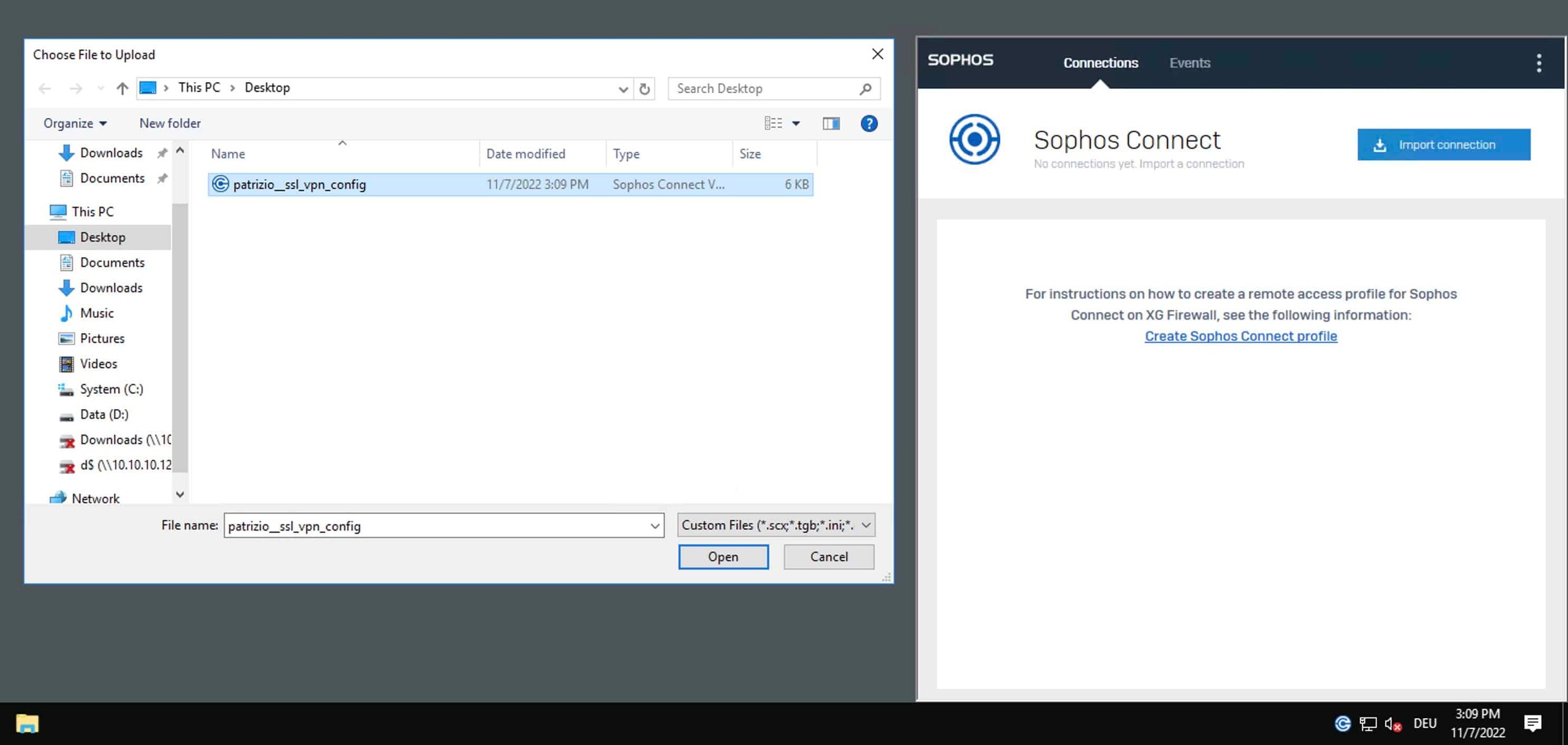

When several profiles exist, the connection name should be clear. Old or duplicate profiles quickly lead to support cases because users select the wrong destination.
With a manually imported .ovpn file, users must download and import the configuration again from the VPN Portal after relevant changes. Sophos specifically identifies changes to the port, protocol, interface or SSL server certificate in the global SSL VPN settings. A client update alone does not require a new profile import; existing configuration files continue to work.
For a connection provisioned through .pro, Sophos Connect retrieves most subsequent configuration changes automatically. After changing the port or protocol in the global SSL VPN settings, the user clicks the profile’s gear button > Update policy. Changes to the port, gateway, SSL server certificate or protocol then require the user to sign in again. If the gateway or VPN Portal port stored in the .pro file changes, distribute a corrected .pro file instead.
Typical signs of an outdated or wrong profile:
- Connection shows old site name: An old profile is usually still imported. Remove the old connection and import the current
.ovpnagain. - Certificate or gateway warning: FQDN, certificate or Override Hostname may have changed. Download the profile again from the current VPN Portal.
- DNS works only on individual clients: Check old DNS values in the profile or local DNS behaviour. Reimport the profile and check Windows DNS.
- User sees no configuration in the portal: Check policy assignment or user context. Verify SSL VPN policy and group membership.
5. Establish the VPN connection
Select the imported connection and click Connect. Then log in with the VPN user. If MFA or OTP is active, confirm the second factor according to the firewall configuration.
After the connection is established, do not only check the status in the client. The decisive question is whether the required internal destinations can be reached.
When Microsoft Entra ID SSO is used, Sophos Connect 2.4 or later on Windows and SFOS 21.5 or later are required. On shared devices, the previous user should select Force SSO re-login from the Sophos Connect menu so that the next user must sign in with their own Entra ID account.
Check after installation
At least these points should be checked with a test user:
- Sophos Connect shows the connection as connected.
- The user receives an IP address from the expected SSL VPN pool.
- Internal DNS names resolve correctly.
- Required servers and applications are reachable.
- Internet behaviour matches the design: Split Tunnel or Full Tunnel.
- The expected firewall rule for traffic from the
VPNzone is visible in Log Viewer. - MFA is requested as planned.
- A deliberately disallowed target remains blocked.
- Disconnecting and logging in again work.
If the connection is established but no access works, the cause is often not the client but firewall rules, DNS, routing or NAT. For analysis, use Test a firewall rule with Log Viewer, Policy Test and Packet Capture.
Quick Windows-Side Check
On the Windows client, simple checks help before changing the firewall configuration:
ipconfig /all
route print
nslookup intranet.example.local
ping 10.10.10.10
The point is not to allow every ping. What matters is whether the client has received an SSL VPN address, whether a route to the internal target network exists, and whether DNS resolves via the expected server. If access works by IP address but not by name, DNS is more likely than the firewall rule.
Operations and security
SSL VPN is a publicly reachable Remote Access service. Therefore, do not document only the installation, but also the operation:
- Update Sophos Connect regularly.
- Enable and test MFA for Remote Access.
- Review VPN groups regularly.
- Restrict portal access through Device Access and Local Service ACL where possible.
- Keep firewall rules for the
VPNzone narrow and logged. - Remove old
.ovpnfiles and outdated profiles. - Plan Syslog or central analysis for longer log retention.
For MFA basics, see Enable MFA for Sophos Firewall WebAdmin, VPN Portal and Remote Access. For log files and service logs, Sophos Firewall troubleshooting: services and logs is useful.
Troubleshooting
Login to the VPN Portal does not work
Check user, password, MFA, group membership and authentication server. If AD, RADIUS or Microsoft Entra ID SSO is involved, test authentication separately from the VPN.
User Sees No SSL VPN Configuration in the VPN Portal
If login works but no .ovpn file or SSL VPN download is visible, do not start with the Windows client. First check SSL VPN policy, Policy members, group membership, portal access, and User-ID limit. The firewall-side process is described in Set up Sophos Firewall SSL VPN Remote Access.
.ovpn file cannot be imported
First check whether the file really belongs to the current firewall configuration and whether Sophos Connect is current enough. For special characters in certificates or user data, use a current client version.
If downloading the .ovpn file in the VPN Portal itself fails even though login and permission are correct, also check the Sophos Firewall User-ID limit.
Connection is established, but internal systems are not reachable
Check DNS, firewall rules, routing, NAT and the return path. Traffic from the VPN zone should be visible in Log Viewer. If no logs appear, the traffic probably does not reach the expected rule or logging is disabled.
If small accesses work but larger file transfers or certain applications hang, also check MTU/MSS: Check Sophos Firewall MTU and MSS for VPN problems.
Sophos Connect reports policy mismatch or compression mismatch
- Policy mismatch with a request to import again: For a manually imported
.ovpnconnection, download the current file from the VPN Portal and import it again. For a provisioned connection, Sophos Connect automatically downloads the new policy and re-establishes the tunnel. - Compression mismatch: For an
.ovpnconnection, reconnect manually. For a.proconnection, Sophos Connect attempts to reconnect automatically.
With TCP, the client detects a changed SSL VPN policy during an existing connection and disconnects or updates it as appropriate. With UDP, the Inactivity Timer may have to expire first. Record the time, protocol and exact event message rather than treating every mismatch message in the same way.
After Profile Change, Sophos Connect Still Connects to the Old Target
Often an old connection entry is still present or users select the wrong profile name in the client. Remove old profiles, import the current .ovpn again and choose the profile name so that site, environment or purpose are clearly recognisable.
Connection drops in third-party networks
SSL VPN is often more tolerant than IPsec, but it is not immune to restrictive networks, Captive Portals, forced proxies or unstable Wi-Fi. In such cases, test with a second network and check whether Split Tunnel, port, protocol or ZTNA is a better fit.
Collect support data
If the error is not directly visible, three-dot menu > About > Generate technical support report creates the scvpntsr.zip file. It contains connection events, VPN configurations and information about the endpoint. Before sharing it, check sensitive data such as usernames, internal hostnames, IP addresses and gateway FQDNs.
On the firewall side, Log Viewer, sslvpn.log, openvpn-status*.log and the matching firewall rule help in parallel. The log file mapping is described in Sophos Firewall troubleshooting: services and logs.